 World of Will
There are places you visit, and then there are places that quietly change you. Samarkand belongs to the second kind.
From the moment I arrived, I felt like I’d stepped into a living storybook — one written not just in stone and tile, but in silence, prayer, snow, and human memory. This isn’t a city you simply see. It’s a city you feel.
Why Samarkand Stays With You
Samarkand is one of those rare places I think everyone should see at least once in a lifetime. Sitting proudly along the ancient Silk Road, it has watched empires rise and fall, cultures collide and blend, and faith quietly shape everyday life for centuries. Amir Temur, the Mongol empires, the arrival of Islam through Arab influence, even the quiet scars left behind by the fall of the Soviet Union — it’s all still here.
History doesn’t sit behind glass in Samarkand. It breathes beside you.
Whether you come on a quick day trip from Tashkent or stay longer to really absorb its rhythm, this city rewards curiosity. Honestly, the only thing you need to bring is an open mind and a willingness to listen. Samarkand gives generously to those who do.
Arriving in Winter, When No One Else Does
I visited in December — a time most travelers hesitate to choose. But winter has always felt special to me. Snow has this way of softening the world and slowing everything down.
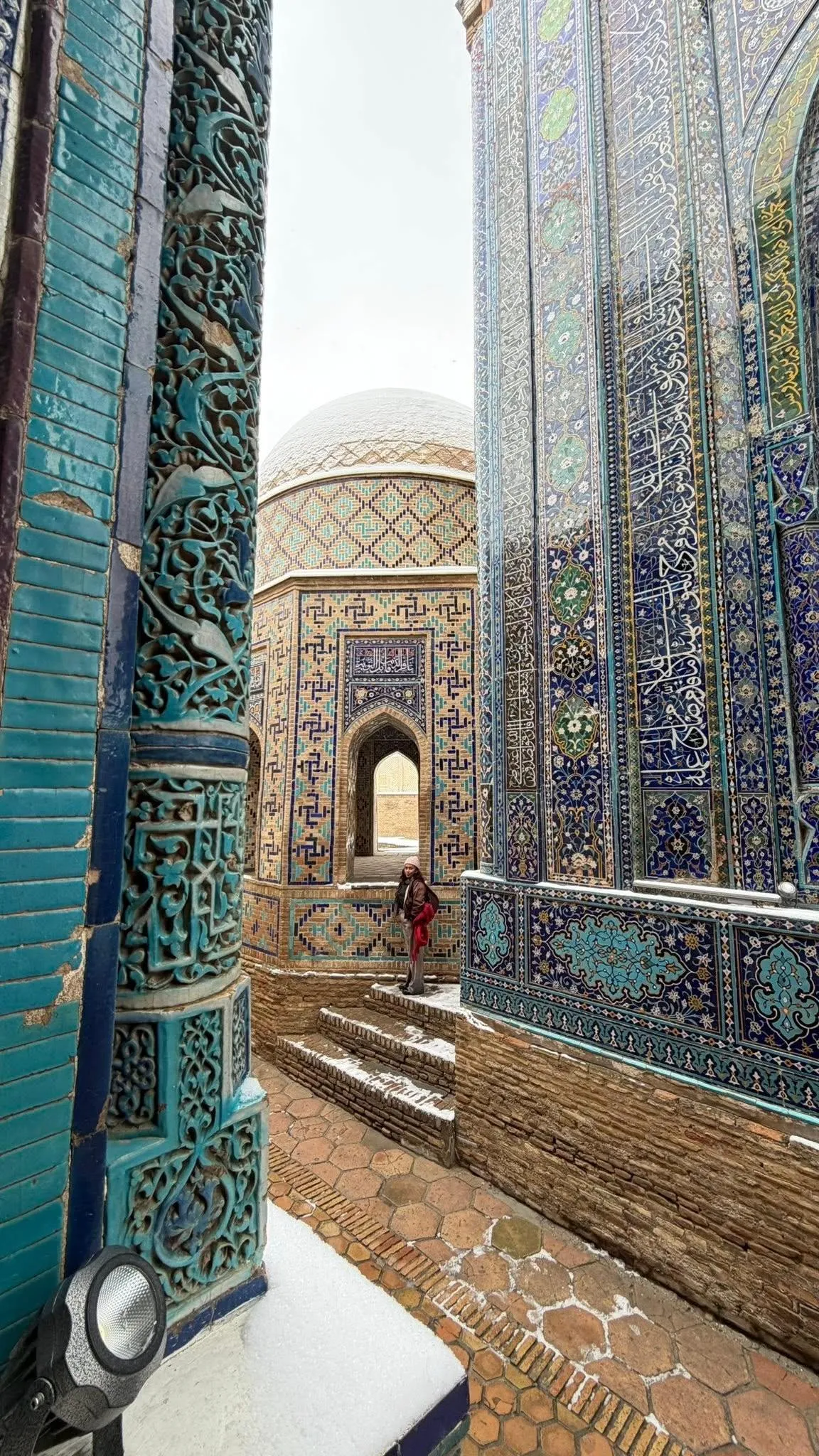
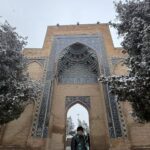
When we arrived and the first snow began to fall, Samarkand transformed into something almost unreal. Blue domes dusted in white. Empty courtyards echoing with footsteps. Cold air that somehow made me feel more awake and alive. Uzbekistan did not disappoint — it felt intimate, peaceful, and, more than once, deeply emotional.
The Five Places Everyone Should See
Most standard city tours in Samarkand center around five UNESCO World Heritage landmarks — and honestly, for good reason. Here’s what stayed with me from each one.
Registan Square
The heart of Samarkand, and one of the most unforgettable places in all of Uzbekistan. The three madrasahs — Ulugh Beg, Sher Dor, and Tilla Kari — stand with incredible scale and elegance. At first, the grandeur is overwhelming, but it’s the details that pull you in: geometric patterns, intricate calligraphy, a quiet symmetry that feels almost spiritual. In the evening, especially during the light and sound show, the square comes alive. It’s not just a place to visit — it’s a place to stay, reflect, and return to after 8:30 p.m.
Shah-i-Zinda
One of the most emotional, atmospheric sites I’ve ever walked through. Known as the “Street of the Dead,” it’s a narrow corridor lined with mausoleums in deep shades of blue. Walking through it feels like stepping into devotion itself. Every tile and tomb tells a story of love, loss, and faith. The silence here is powerful — it makes the whole experience even more moving.
Gur-e-Amir Mausoleum
The resting place of Amir Temur, and it carries a strong sense of history and legacy. Its golden dome shines even under gray skies. Inside, the air feels heavy with power and significance — a reminder that great empires and leaders once shaped the world from right here. History feels very present in this place.
Bibi-Khanym Mosque
A monument to ambition and vision. Once among the largest mosques in the Islamic world, it still stands today despite partial ruin. Its scale remains majestic, reflecting both human aspiration and the passage of time. Even in imperfection, it feels grand and deeply moving, as if echoes of prayer still linger in its walls.
Ulugh Beg Observatory
A surprising highlight that reveals Samarkand’s scientific brilliance. Built in the 15th century, it was once a center of astronomical discovery. Standing here, I felt a deep respect for a civilization that studied the stars while staying deeply connected to the earth — proof that this region was a center of science as much as faith and trade.
Getting There and Getting Around
There are a few different ways to experience Samarkand, depending on how you like to travel.
Private city tours are ideal if you want flexibility and depth. Most run five to eight hours and include hotel pickup with air-conditioned transport. What made my experience truly unforgettable, though, was my guide — a great guide doesn’t just explain history, they become an extension of you in the place you’re visiting. I actually wrote a whole separate post about that experience, which you can read here.
If you’re based in Tashkent, day trips are wonderfully easy thanks to the high-speed Afrosiyob train — in just two hours, you’re transported into another world entirely. Plenty of agencies offer all-inclusive packages with train tickets, a local guide, and transportation within the city.
If you want something a little different, Samarkand also has niche experiences worth building into your trip:
- Cross-border day trips to the Seven Lakes in Tajikistan, through the stunning Fann Mountains
- Cultural workshops like bread making, or a visit to the Konigil Meros paper factory — watching mulberry paper being made by hand was simple, quiet, and deeply grounding
A Few Practical Notes
Practical details never define a trip, but they do make it smoother, so here’s what I’d tell a friend before they go:
- Best time to visit: Spring and autumn bring the mildest weather — though winter gave me something special: fewer crowds, softer moments, and a deeper connection to the city.
- Getting around: The Yango app is reliable and affordable for taxis.
- Trains: Book Uzbekistan Railways tickets 45–60 days in advance — they sell out fast.
- Dress code: Cover shoulders and knees when visiting religious sites. It’s a small gesture of respect that goes a long way.
- Visas: Travelers based in the UAE with a residence visa don’t need a visa to enter Uzbekistan. Philippine passport holders need to apply online in advance.
- Flights: Flying from the UAE is affordable, especially with Fly Dubai — about four and a half hours of travel time.
Why I’ll Never Forget This City
Samarkand reminded me why I travel in the first place. Not to tick boxes, but to feel connected — to understand that the world is layered, complex, and beautiful in ways no photo can fully capture.
This city teaches patience, humility, and wonder. It reminds you that civilizations rise, people pray, empires fall — but beauty remains.
Samarkand isn’t just a destination. It’s a lesson. A feeling. A quiet love letter to humanity. And once it enters your heart, it never really leaves.
A Few More Frames From Samarkand

Leave a Reply